Why adjustments alone sometimes will not hold
If you have ever left a chiropractic office feeling great and been tight again by the next morning, chronic soft tissue restriction is usually why. Muscle and fascia that have been laid down with scar tissue act like a rubber band pulling a joint back out of position. Restore the joint without addressing the tissue and the tissue wins.
Our muscle protocol exists to fix that. It is a deliberate two-step process performed before or alongside your adjustment.
Step one, therapeutic ultrasound
Ultrasound sends high-frequency sound waves into tissue well below what any hands-on technique can reach. That produces deep heating, increases local circulation, and makes collagen more pliable. It also feels like nothing more than a warm massage head moving over your skin.
The purpose is preparation. Working on cold, guarded fascia is both less effective and more uncomfortable. Warming the tissue first means the second step does more with less force.
Step two, adhesion work
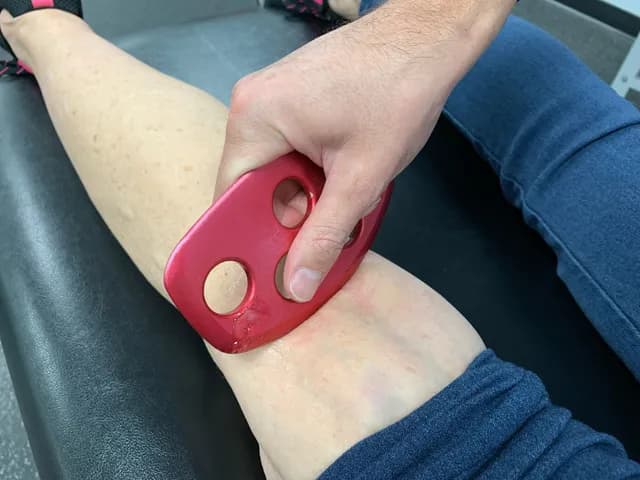
We then use instrument-assisted soft tissue technique to find and break down adhesions, the disorganized cross-linked collagen your body deposits after injury or chronic overuse. Running a beveled instrument along the tissue lets us feel restriction that fingers cannot detect, and the controlled microtrauma it creates triggers your body to remodel that scar tissue along proper lines.
Patients feel a gritty, speed-bump sensation as the instrument crosses an adhesion, which usually smooths out within a session or two. Mild bruising is possible and normal. The measurable outcome is improved fascial mobility and genuinely restored range of motion, not just a temporary loosening.
Benefits of muscle protocol & soft tissue therapy
- Breaks down scar tissue and fascial adhesion
- Restores true range of motion, not just temporary looseness
- Increases circulation to chronically tight tissue
- Makes adjustments hold longer
- Speeds recovery from strains and overuse injuries
Conditions we use this for
Shoulder Pain
The shoulder trades stability for range of motion, which is exactly why it goes wrong so often, and why local treatment alone rarely fixes it.
Neck Pain
Your head weighs about twelve pounds, and every inch it drifts forward multiplies the load your neck has to hold all day.
Back Pain
The most common reason people find us, and one of the most treatable, once you know what is actually causing it.
Tennis Elbow & Golfer's Elbow
Tendon pain at the elbow that grips, lifts, and shakes hands, and that rarely comes from the elbow itself.
Plantar Fasciitis & Heel Pain
That stabbing pain on your first steps out of bed is the most recognizable symptom in musculoskeletal medicine, and one of the most frustrating to wait out.
Hip Pain
Stiff, weak hips do not stay a hip problem for long. They hand their workload to the low back and the knees.
Muscle Protocol & Soft Tissue Therapy: common questions
Is soft tissue work painful?
It is best described as intense but productive, the good kind of sore. Because we warm the tissue with ultrasound first, we can use meaningfully less pressure than a cold session would require. We adjust intensity to your tolerance constantly.
Will I bruise?
Light bruising or redness can occur, especially over long-standing adhesions, and it fades within a few days. It is a normal response to the controlled microtrauma that drives remodeling, not a sign something went wrong.
How is this different from a massage?
Massage is broad and primarily relaxing. This is diagnostic and targeted: we are locating specific adhesions and specific restrictions and remodeling them. Both have value, but they are solving different problems.