
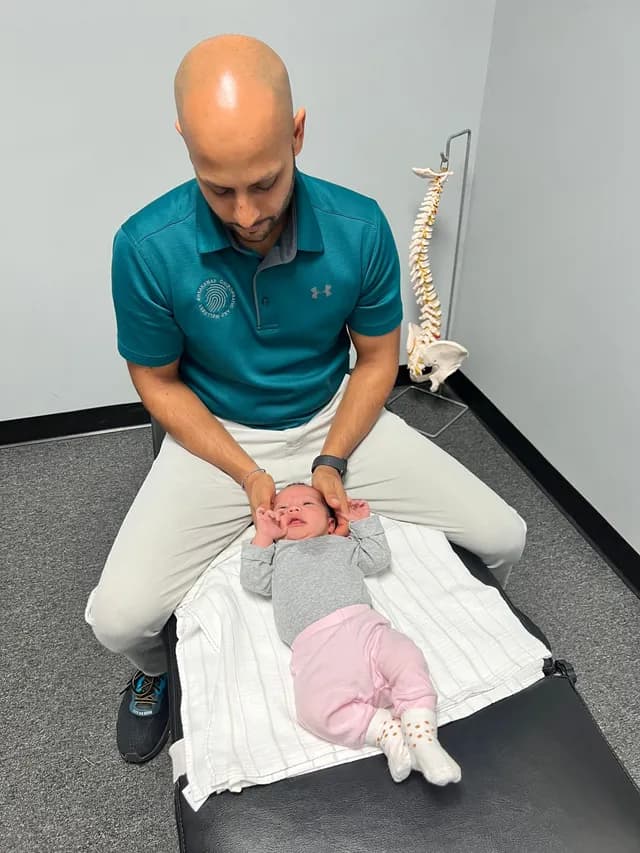
How gentle is gentle
This is the first question every parent asks, and it deserves a direct answer. Adjusting an infant does not resemble adjusting an adult in any way. There is no twisting, no thrust, and no popping sound. We use sustained fingertip pressure of roughly two ounces, about what you would use to check whether a tomato is ripe, held against a specific spot for a few seconds.
Most babies sleep through it. Many parents watching for the first time are surprised that it is already over.
Why babies develop restrictions at all
Birth is a mechanical event. Even an uncomplicated delivery applies significant force to a newborn's neck and skull, and interventions like vacuum extraction, forceps, prolonged pushing, or a rapid delivery add more. That can leave the upper cervical spine restricted on one side.
The downstream effects are often what brings parents in: a baby who will only turn their head one way, who latches well on one breast and fights the other, who arches and cries in the evenings, or who never seems to settle.
What parents bring their children in for
Our pediatric patients come in for colic and inconsolable evening crying, latching and feeding difficulty, torticollis and head-turning preference, reflux and digestive discomfort, constipation, poor sleep, recurring ear infections, and postural issues in older kids, including the neck and shoulder problems that come from years of tablets, laptops, and heavy backpacks.
We want to be clear about what we are and are not claiming. Chiropractic care does not treat infection and it is not a substitute for your pediatrician. What we address is mechanical: restricted joints and the nervous system irritation that comes with them. Many parents report meaningful improvement in these areas, and we work alongside your pediatrician rather than in place of them.
Benefits of pediatric chiropractic care
- Extremely gentle, low-force techniques appropriate for infants
- Support for feeding, latching, and head-turning symmetry
- Help with sleep, digestion, and colic-related discomfort
- Postural correction for school-age children
- A calm, kid-friendly office your child will not dread
Conditions we use this for
Colic & Infant Discomfort
Gentle care for the inconsolable evening crying, arching, and feeding struggles that exhaust new parents.
Infant Torticollis
When a baby strongly prefers turning one direction, and the flat spot, feeding trouble, and frustration that follow.
Recurring Ear Infections
For families dealing with one round of antibiotics after another, a drainage-focused approach that works alongside your pediatrician.
Text Neck & Posture Problems
Forward head posture is not a cosmetic issue. It is a mechanical load your neck carries for ten hours a day.
Scoliosis
Curve monitoring, pain management, and mobility support for children, teens, and adults, with honest scope about what chiropractic can and cannot do.
Pediatric Chiropractic Care: common questions
Is chiropractic safe for babies?
When performed by a doctor trained in pediatric technique, yes. The forces used on an infant are a tiny fraction of adult forces, roughly the pressure you would apply to your closed eyelid. We take a full birth and health history first and will refer you to your pediatrician if anything we find falls outside our scope.
How young is too young?
We have adjusted babies within their first weeks of life. There is no minimum age. What changes with age is technique, not whether care is appropriate.
Will my child be scared?
Almost never, and that surprises parents. Because there is no forceful thrust and no sound, children generally find it non-threatening. We let them watch a sibling or parent get adjusted first, and we never rush a nervous kid.
How often will my child need to come?
Children typically respond much faster than adults. Their tissues are more adaptable and they have not been compensating for decades. Many pediatric plans are short, in the range of a handful of visits, with occasional check-ins during growth spurts.